Why Most Food Businesses Quietly Lose 5–10% Margin Every Month
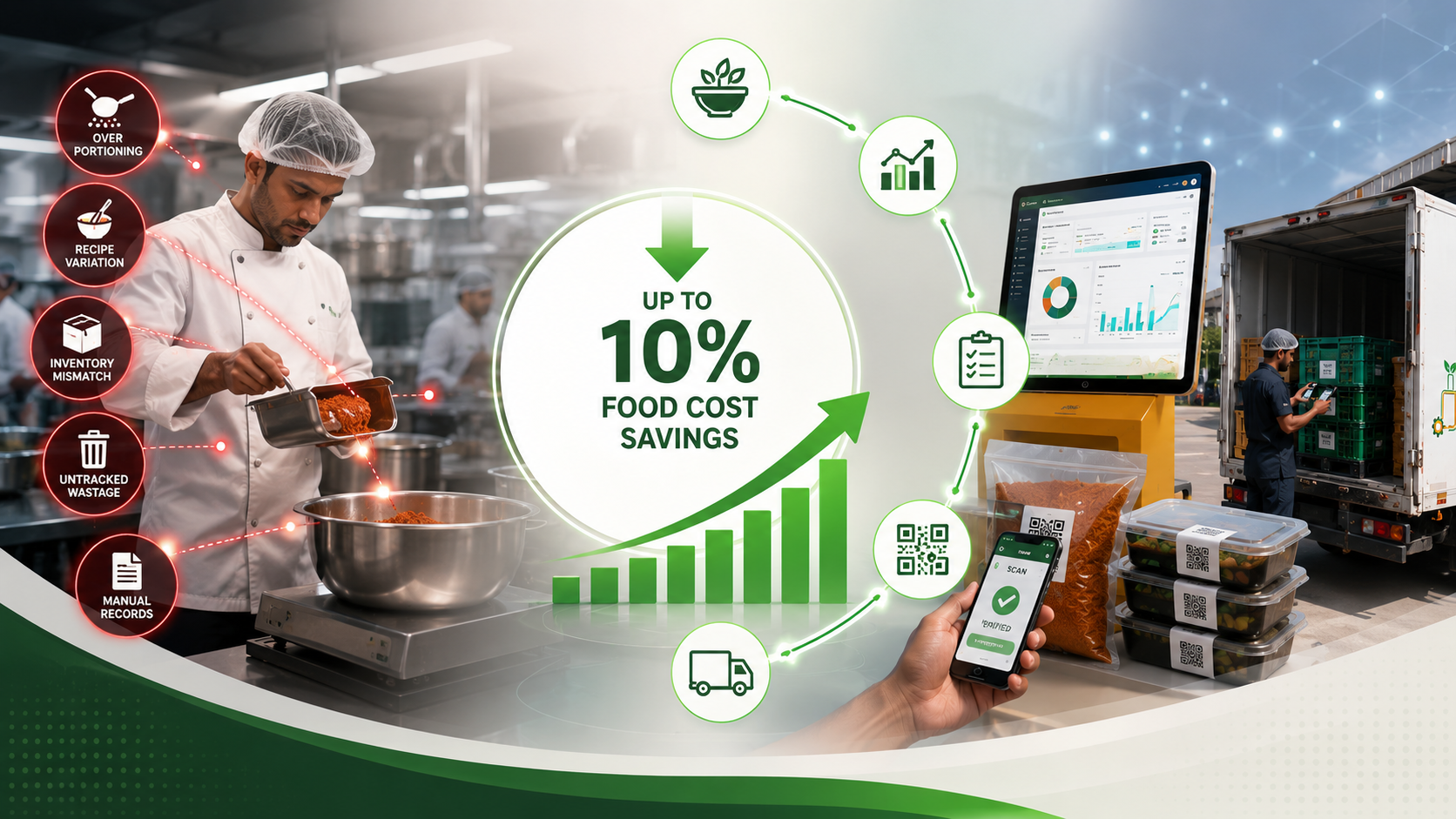
In the food industry, profitability rarely disappears in one dramatic moment. It leaks slowly. A little extra ingredient usage during production.
- Slight overfilling on the kitchen floor.
- Yield variation across shifts.
- Inventory mismatches between physical stock and ERP records.
- Untracked wastage during preparation and dispatch.
Individually, these issues seem operationally small. Collectively, they quietly erode margins every single day. This is one of the biggest hidden realities inside food manufacturing and central kitchen operations today:
most food businesses are unknowingly operating with invisible operational leakages. And as companies scale across multiple outlets, production units, and supply chains, these inefficiencies compound rapidly. This is exactly why food company CEOs and CXOs are increasingly searching for:
how to reduce food cost in central kitchens, food production management systems, AI ERP for food manufacturing, and real-time food traceability platforms. Because traditional systems are no longer enough.
The Real Reason Food Costs Spiral Out of Control
Most businesses assume rising food cost comes mainly from procurement pricing. But in reality, a significant percentage of operational losses happen after raw materials enter the kitchen. The actual leakage happens during:
raw material issuance, recipe execution, production handling, yield capture, packaging, and dispatch. And most of these activities still operate manually in large parts of the industry. Production teams often depend on:
paper records, supervisor observation, verbal communication, and manual ERP entries. The challenge is not effort. The challenge is visibility.
Without real-time operational control, businesses struggle to answer basic questions:
How much raw material was actually consumed?
Did the batch yield match standard output?
Which shift caused higher wastage?
Was the recipe executed correctly?
Did dispatch quantities match production?
Where exactly did excess consumption happen? When businesses cannot measure operational reality accurately, controlling food cost becomes almost impossible.
Why Traditional ERP Systems Fail to Solve Food Cost Problems
Most ERP systems were designed primarily for accounting, procurement, and transaction management. They work well for finance. But food manufacturing operates very differently. A food business is dynamic.
Recipes vary, Yields fluctuate, Ingredients are perishable.
Production decisions happen in real time. Traditional ERP systems usually capture information after operations are completed. By then, the damage is already done. The system may show theoretical inventory consumption, but it rarely captures actual shop-floor execution. This creates a dangerous operational gap between:
what should happen and what actually happens. And that gap directly impacts profitability.
UdyogYantra.AI: AI-Powered Operational Control for Food Manufacturing
UdyogYantra.AI was built specifically to solve this execution gap. Instead of functioning only as a passive ERP layer, it acts as an AI-native operational control system for food manufacturing and central kitchens. The objective is simple:
capture operational truth directly from the shop floor in real time. The platform connects:
raw material inwarding, recipe-based RM issuance, production execution, food traceability, packaging, dispatch, and outlet inventory movement into one live operational ecosystem. This creates end-to-end supply chain visibility for food businesses. More importantly, it creates operational accountability. Every ingredient movement becomes digitally traceable.
Every batch becomes measurable.
Every production workflow becomes standardized. And once operational visibility improves, food cost starts stabilizing naturally.
How UdyogYantra.AI Helps Reduce Food Cost by Up to 10%
The impact of operational visibility on profitability is often underestimated. In reality, some of the biggest food cost savings come from fixing small operational inefficiencies at scale.UdyogYantra.AI helps businesses reduce food cost leakage through multiple operational control layers. Recipe-based raw material issuance prevents uncontrolled consumption before production even starts.AI-guided production workflows reduce recipe deviations and improve consistency across shifts. Real-time yield capture highlights batch inefficiencies instantly instead of weeks later. QR-based food traceability reduces inventory leakages and improves accountability across operations. Digital production tracking eliminates dependency on paper records and delayed manual reporting. Dispatch verification ensures accurate finished goods movement during loading and outlet distribution. Individually, each improvement may appear operational. Together, they create measurable financial impact.
This is why many businesses experience food cost optimization of up to 5–10% after implementing structured operational control systems.
Central Kitchen Management Needs Real-Time Intelligence
Modern food businesses increasingly operate through centralized production models.
One central kitchen may supply:
Restaurants, cloud kitchens, retail stores, airline catering, industrial catering operations, or quick commerce networks. As complexity increases, manual supervision stops scaling effectively. This is why Central Kitchen Management Platforms are becoming critical operational infrastructure.
Businesses today need systems capable of:
Live production monitoring, inventory visibility, production planning, recipe compliance, and end-to-end food traceability. UdyogYantra.AI enables this through AI-powered operational workflows designed specifically for food manufacturing environments.The system transforms food operations from reactive management into proactive control.
Operational Discipline Creates Scalability
One of the biggest challenges in scaling food businesses is maintaining consistency across people, shifts, and locations. Most businesses remain heavily dependent on experienced supervisors and operational tribal knowledge. But scalable businesses cannot depend entirely on human memory and manual checks. They require operational systems that enforce consistency structurally. This is where AI-powered food production management becomes transformational. UdyogYantra.AI embeds operational discipline directly into workflows. Recipes become digitally guided.
Material movement becomes system verified.
Production becomes measurable.
Traceability becomes automatic.This reduces dependency on manual discretion and creates far more predictable operations.
Food Traceability is No Longer Just About Compliance
Historically, food traceability was viewed mainly through the lens of audits and regulations. Today, it has become a core business advantage. Brands that can track every ingredient, every batch, and every dispatch movement build stronger operational confidence and customer trust. At the same time, food traceability improves internal control dramatically.
Businesses gain:
better inventory visibility, faster issue identification, stronger quality accountability, and improved supply chain transparency.UdyogYantra.AI enables end-to-end food traceability through QR-based operational mapping integrated directly into production workflows. This creates a digital operational backbone for modern food businesses.
The Future of Food Manufacturing Will Belong to Operationally Intelligent Companies
The next generation of successful food businesses will not compete only on branding or distribution.They will compete on operational intelligence.The companies that can:
reduce food cost leakage, improve consistency, build live supply chain visibility, and scale operations with structured control will gain a massive advantage.This is why AI ERP for Food Manufacturing is becoming one of the most important technology shifts in the industry.And this is exactly where UdyogYantra.AI is positioning itself:
as the AI-native operational ERP layer for food manufacturing and supply chains.
Conclusion
Food businesses do not lose profitability overnight.Margins erode slowly through invisible operational inefficiencies that compound over time.Without real-time production visibility, structured food traceability, and operational control, even the best brands struggle to maintain predictable profitability at scale.UdyogYantra.AI helps solve this through AI-powered operational infrastructure built specifically for food manufacturing and central kitchen management.From sourcing to production to dispatch, every operational movement becomes measurable, traceable, and controllable.Because in modern food manufacturing, operational visibility is no longer optional.It is directly linked to profitability.