Why ERP and POS Systems Fail to Control Food Operations — And What’s Missing?
Most food businesses today are digitally enabled.They have:
- A POS system to track sales
- An ERP to manage inventory and finance
- Dashboards to monitor performance
On paper, everything looks structured.Yet, the same problems persist:
- Food cost keeps creeping up
- Inventory never matches exactly
- Production varies across shifts
- Managers spend time firefighting instead of scaling
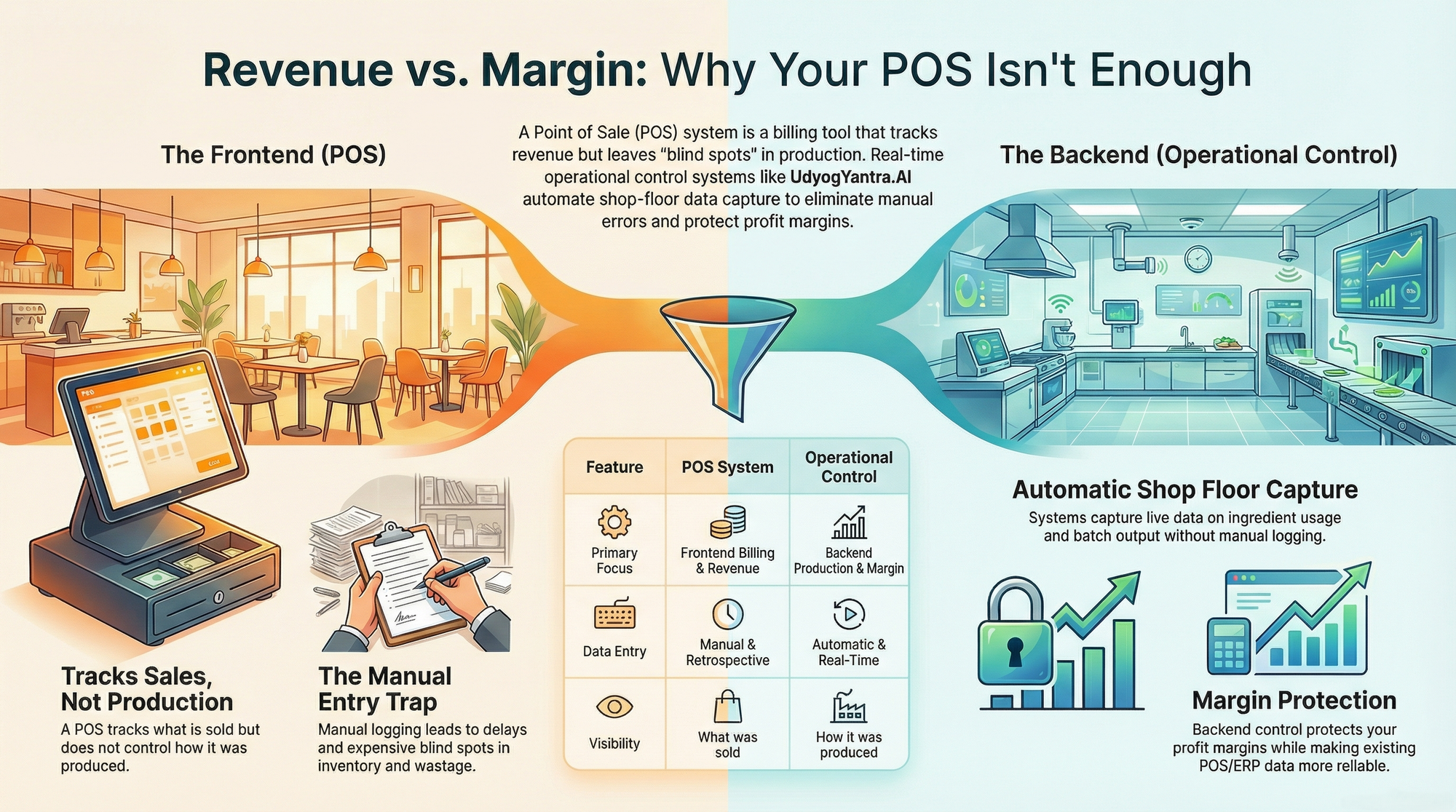
So, where’s the gap? The answer is simple — and uncomfortable: Most systems record what happened. They don’t control what happens.
The Comfort of Systems — and the Illusion of Control
POS and ERP systems are essential.
But they were never designed to control kitchen operations.
A POS answers: What was sold?
An ERP answers: What should have been used?
But neither answer: What actually happened on the kitchen floor?
That gap is where inefficiencies hide.
The Real Problem: Manual Dependency
Let’s break it down.
Inventory Entry Is Manual
Raw material inwarding, stock updates, and adjustments are often entered manually. Which means:
- Errors go unnoticed
- Data can be delayed or manipulated
- Real stock vs system stock diverges
Recipe Consumption Is Assumed
Most systems deduct inventory based on standard recipes. But in reality:
- Workers use slightly more or less
- Ingredients get substituted
- Steps are skipped
So, your system shows theoretical consumption — not actual.
Production Is Not Verified
Once production starts:
- There is no real-time validation
- No enforcement of SOPs
- No visibility into deviations
Supervisors try to manage this.
But supervision is inconsistent and doesn’t scale.
Quality Is Checked After the Fact
Most quality checks are retrospective. Which means:
- Problems are discovered late
- Rework or wastage increases
- Root cause is unclear
Dispatch Is Prone to Errors
Without system validation:
- Wrong SKUs get packed
- Quantities mismatch
- No batch traceability exists
And once goods leave the kitchen, control is lost.
Why This Matters More Than You Think
Individually, these issues seem small. But together, they create:
- 5–10% food cost leakage
- Inconsistent product quality
- Inventory mismatches
- Operational inefficiency
And most importantly:
Lack of trust in your own data.
The Missing Layer: Execution Control
What’s missing in most food tech stacks is a system that:
- Works on the shop floor
- Captures data automatically
- Enforces processes in real time
In other words, a system that doesn’t just record operations —
but actually, controls them.
Introducing the Execution Control Layer
This is where UdyogYantra.AI fits in. Think of it as the layer between:
Your planning systems (ERP/POS)
and
Your actual operations (kitchen floor)
How UdyogYantra.AI Complements ERP and POS
UdyogYantra.AI does not replace your existing systems. It strengthens them.
1. From Manual Entry to Automatic Capture
Instead of relying on manual data entry:
- Raw materials are QR coded
- Movements are scan-based
- Production data is captured automatically
Your ERP now receives clean, real-time data.
2. From Assumed Consumption to Actual Usage
Instead of deducting based on recipes:
- Ingredient usage is measured live
- Variances are captured instantly
- Batch-level consumption is recorded
Your costing becomes accurate, not theoretical.
3. From SOPs on Paper to SOPs in Action
Instead of training-dependent execution:
- AI Kitchen Workstations guide every step
- Recipes are enforced in sequence
- Errors are flagged immediately
Your processes become repeatable and reliable.
4. From Delayed Visibility to Real-Time Insight
Instead of waiting for reports:
- Production data is live
- Inventory is updated instantly
- Issues are detected early
Your decisions become faster and better.
5. From Disconnected Systems to One Flow
UdyogYantra.AI connects: Sourcing → Production → Dispatch → Outlet
All data flows into your ERP and POS.
Which means:
- One version of truth
- Full traceability
- End-to-end visibility
The Business Impact
When execution is controlled, everything improves.
Better Food Cost Control
By eliminating:
- Overfilling
- Wastage
- Untracked consumption
Businesses typically see:
5–10% reduction in food cost
True Batch Costing
You can finally answer:
- What did this batch cost?
- Where did variance occur?
- Why did margin drop?
With confidence.
Reduced Training and Supervision Costs
Because:
- Workers are guided by systems
- Processes are standardized
- Less dependency on skilled staff
Scalable Operations
You can:
- Add shifts without losing control
- Expand kitchens without chaos
- Maintain consistency across locations
Reliable Data for Leadership
No more:
- Guesswork
- Adjustments
- “Approximate numbers”
Just:
- Accurate
- Real-time
- Actionable data
A Simple Way to Think About It
POS tells you:
What you sold ERP tells you:
What should have happened UdyogYantra.AI tells you:
What actually happened — and ensures it happens correctly
The Future of Food Operations
As food businesses scale, the complexity increases. More SKUs.
More kitchens.
More workers.
More variability. In this environment, systems that rely on manual input and supervision will fail. The future belongs to:
- Automated data capture
- AI-driven execution
- Real-time control
Conclusion: Control Is the Missing Link
Food businesses don’t fail because they lack systems. They fail because their systems don’t control execution. UdyogYantra.AI fills that gap. Not by replacing what you already have —
but by making it work the way it was meant to. Because in food operations:
Control is not optional. It is foundational.
Final Thought
If your numbers don’t match your reality,
it’s not a reporting problem. It’s an execution problem.